DeepTech
October 8, 2025


A joint interview with Didier Genoud, Managing Partner at Ciclad, and Olivier Dubuisson, Managing Partner at Karista
Olivier Dubuisson - I believe this is not just a European issue, but a global one. Defence has been thrust back to the forefront by geopolitical developments. We are entering an environment where conflict has once again become a structural reality, affecting everyone. European states have also acknowledged their lag and voted massive rearmament plans. Large-scale public investment inevitably creates industrial opportunities -acquisitions, consolidation, and growth. It is a very clear and fertile investment landscape.
Didier Genoud - Taking a step back, we can see that defence follows long cycles. Between 1970 and 1990, defence budgets increased significantly. Then, from 1990 to 2010, we experienced the so-called “peace dividend”: budgets declined and defence became a shrinking sector. Overthe past decade - and very markedly since 2022 - we have entered a phase of rapid catch-up. Current budget trajectories bear no comparison with previousdecades. This is not a trend; it is a structural shift in the world order.
Olivier Dubuisson - At Karista, we invest in defence innovation. One of our primary concerns is dependence on public procurement. A start-up cannot survive on government contracts alone - decision cycles are simply too long. That is why we pay close attention to “dual-use” businessmodels, with both civilian and military applications. In our view, this reduces risk, enables faster revenue generation, and broadens exit options.
Didier Genoud - We invest in more mature SMEs.Our criteria are similar in spirit, but applied differently. We focus first on management quality, barriers to entry, and strategic differentiation. The objective is clear : between entry and exit, the company must scale significantly. Dual-use is also important for us, as it secures growth trajectories, but the issue is not the same as for a still-fragile start-up.
Didier Genoud - Yes, it is a false debate. Thewar in Ukraine illustrates this very clearly. On the one hand, certain technological innovations have had a decisive impact. On the other, it is also a highly conventional war, with massive needs for heavy industrial capabilities. Both are indispensable. They should not be set against one another.
Olivier Dubuisson - I would add that innovation isnot limited to disruption. Incremental innovation is essential: improving existing systems, optimising technologies, increasing efficiency. This is often where the link is created between established industrial players and start-ups. Not everything depends on radical technological breakthroughs.
Olivier Dubuisson - Today, links are still insufficient, particularly with SMEs. Start-ups often struggle to access the market, while SMEs have that access but sometimes lack innovative technological building blocks. There is clear potential for cooperation, but it remains to be structured. That is certainly our ambition.
Didier Genoud - This is precisely where investors can play a very concrete role. At Karista and Ciclad, we act as connectors:we introduce people, facilitate exchanges, and encourage cross-expertise. Regular discussions with innovation-focused funds are extremely valuable to us. They save time, help avoid mistakes, and sometimes accelerate industrialdecisions.
Olivier Dubuisson - Yes, but not under allconditions. Once again, dual-use is key. Without it, long decision and payment timelines can put companies - especially younger ones - under severe strain.
Didier Genoud - Long cycles are not necessarily a drawback. For an SME that needs to invest heavily in industrial tools, having ten-year visibility can actually be a major advantage. In today’s highly uncertain economic environment, defence is one of the few sectors where such visibility genuinely exists.
Olivier Dubuisson - We are a private fund, not a sovereign one. We invest in European defence, but we must preserve exitoptions, including outside Europe, in strict compliance with French and European regulations. Sovereignty is a framework, not an ideological constraint.
Didier Genoud - On our side, we fully embrace the fact that supporting EDTIB SMEs contributes to sovereignty. That said, we remain a private fund with a clear value-creation objective. Today, investor and citizen interests converge: defence is a deep, durable and strategicmarket.
Olivier Dubuisson - It is taking shape, but a keylink is still missing: a large European fund capable of supporting companiesover the very long term, with significant resources.
Didier Genoud - Bpifrance already plays acrucial role and deserves recognition. As Olivier mentioned, there is also alack of a non-listed alternative to IPOs for large European players. Apan-European sovereign fund could be a solution.
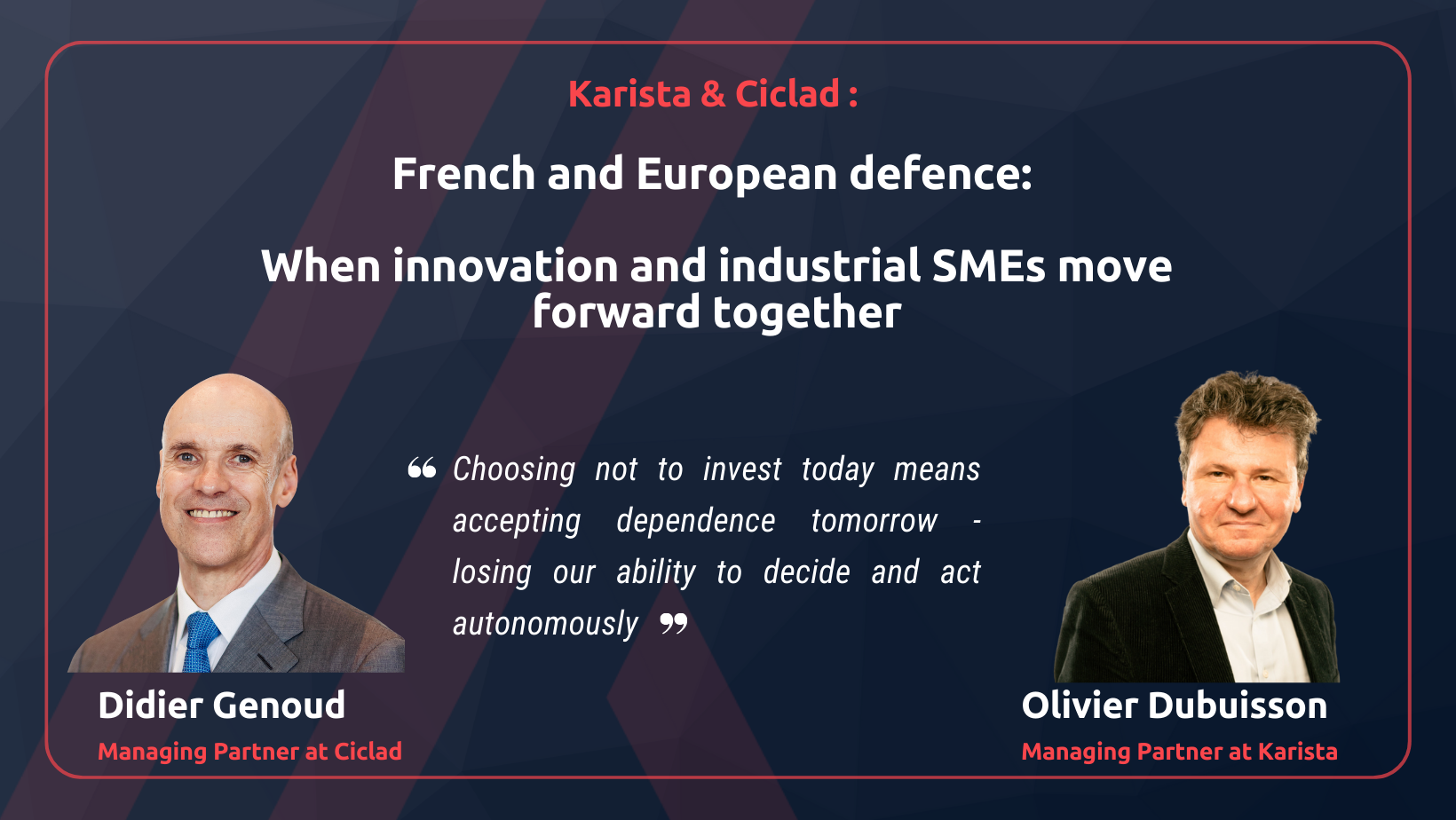
Didier Genoud - The risk is quite clear:strategic decline. We operate in an environment where certain actors disregard international law and historical balances, and think in the long term throughhighly structured industrial and military strategies. In such a context,weakness is not an option. Not investing today means accepting dependencetomorrow - losing our ability to decide and act autonomously.
Olivier Dubuisson - All the more so because Europe,and France in particular, still has major industrial strengths. We have a complete, high-performing defence industrial and technological base, capable of innovating and producing across the entire value chain. Failing to support this ecosystem would be a major strategic mistake - it would mean relinquishing a real competitive edge that would be extremely difficult to recover, and durably weakening our sovereignty, at a time when needs and capabilities clearly exist.
Olivier Dubuisson - Germany will clearly play agrowing role in the European defence ecosystem, both through the scale of itsinvestments and its industrial capacity. Space will also become a centralpillar of defence strategies - for surveillance, communications, intelligence and the protection of critical infrastructure. That said, I believe more instrengthened European coordination than in fully integrated defence: national sovereignties will remain central, but they will need to be better articulatedto gain collective efficiency.
Didier Genoud - In this landscape, private equity will play a very concrete and pragmatic role. It will primarily involve fostering industrial consolidation, supporting SMEs in scaling up and deploying at European level, and building operational bridges between players that still too often operate in national silos. It is often at this intermediate level -that of companies and industrial projects - that Europe truly makes progress and turns political intent into real capabilities.